
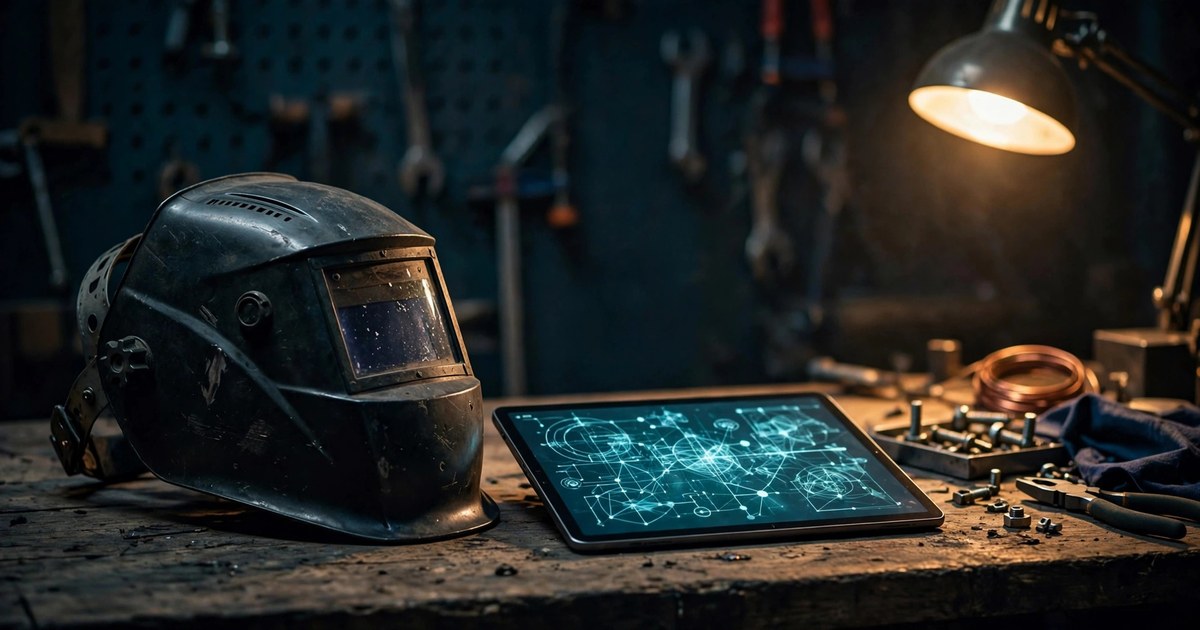
People picture welding school as sparks flying and the hood down. And sure, that's the good part. But nobody tells you before you sign up: for every hour under the hood, there's a pile of theory waiting — weld symbols, process differences, machine settings, safety procedures. Pages of it, and it all shows up on tests whether your beads look good or not.
I'm working through a welding diploma right now — SMAW (stick), GMAW (MIG), GTAW (TIG) — and I'll be straight: I'm not a natural memorizer. Flashcards never stuck for me. So I built a study system around the free AI tools on my phone. Not as a shortcut. As a sparring partner.
The Quiz Loop: My Number-One Trick
Reading a chapter twice never taught me anything. Being tested on it does:
"Quiz me on fillet weld symbols, one question at a time. Tell me if I'm right or wrong, and if I'm wrong explain briefly. 10 questions. Don't move on until I answer."
It asks, I answer, it corrects me on the spot. Ten minutes of this sticks better than an hour of re-reading, because my brain has to retrieve the answer instead of just recognizing it. I run the same loop for everything memorizable: process characteristics, electrode classifications, PPE requirements. One topic, short sessions, always active recall.
Understanding Settings Instead of Memorizing Numbers
A settings chart tells you what. It doesn't tell you why — and "why" is what lets you troubleshoot when a weld goes wrong in the booth:
"Explain what voltage does vs. wire feed speed in GMAW, in plain language. Then tell me what the weld looks like when voltage is too high, and when wire speed is too high."
Now when my bead is ropey or I'm getting spatter, I have a mental model instead of just guessing at dials.
The hard rule: AI is my tutor, not my textbook. If it disagrees with my class notes or my instructor, the instructor wins. Every time. AI is confident even when it's wrong — and in a trade, you verify against the real source.
Drilling Safety Procedures
Safety theory is the part you cannot get wrong, so I use AI as a drill sergeant, not an authority:
"Give me a pre-weld safety checklist for SMAW as a numbered list. Then quiz me — remove one random item each round and ask me what's missing."
The "what's missing" game forces you to hold the whole checklist in your head at once — exactly what you need standing at the booth. And the verification rule applies double here: I compare every AI checklist against the shop's actual procedures. The shop standard is always the final word.
My Actual Routine
- After shop (15 min): dump what confused me into the AI while it's fresh. "My TIG arc kept wandering — what causes that?" Plain answers, no judgment.
- Night before a test: quiz mode, one topic at a time, until I go 10-for-10 twice in a row.
- Sunday: "Summarize what I should review this week based on our conversations" — it remembers what I struggled with and builds the hit list.
What AI Can't Do
AI has never struck an arc. It can't teach puddle control or fix your travel speed. Every minute under the hood is worth ten of theory chat. What it can do is make the hours between booth sessions count — so when you're under the hood, you're thinking about the puddle, not trying to remember what the symbol meant.
Frequently Asked Questions
Can AI be trusted for technical trade info? For study and quizzing, yes — with the verification rule. Learn, drill, and understand with AI, then confirm anything critical against your textbook and instructor. Never treat it as the authority on safety or specs.
Does this work for other trades? Absolutely. Same system for electrical code, plumbing theory, automotive diagnostics: quiz loops for memorization, plain-language explanations for understanding, real training materials as the final word.
The Bottom Line
Theory used to be my weakest link. Now it feels like a game: quiz loops for memorization, plain-English explanations for understanding, instructor's word as law over all of it.
AI won't make you a welder. Booth time makes you a welder. But it makes sure that when you're in the booth, you're thinking about the weld — not the textbook.
Disclosure: This post contains affiliate links. If you buy through them, I may earn a commission at no extra cost to you.



Comments (0)
No comments yet — be the first. Comments are moderated, so yours will show up after a quick review.