
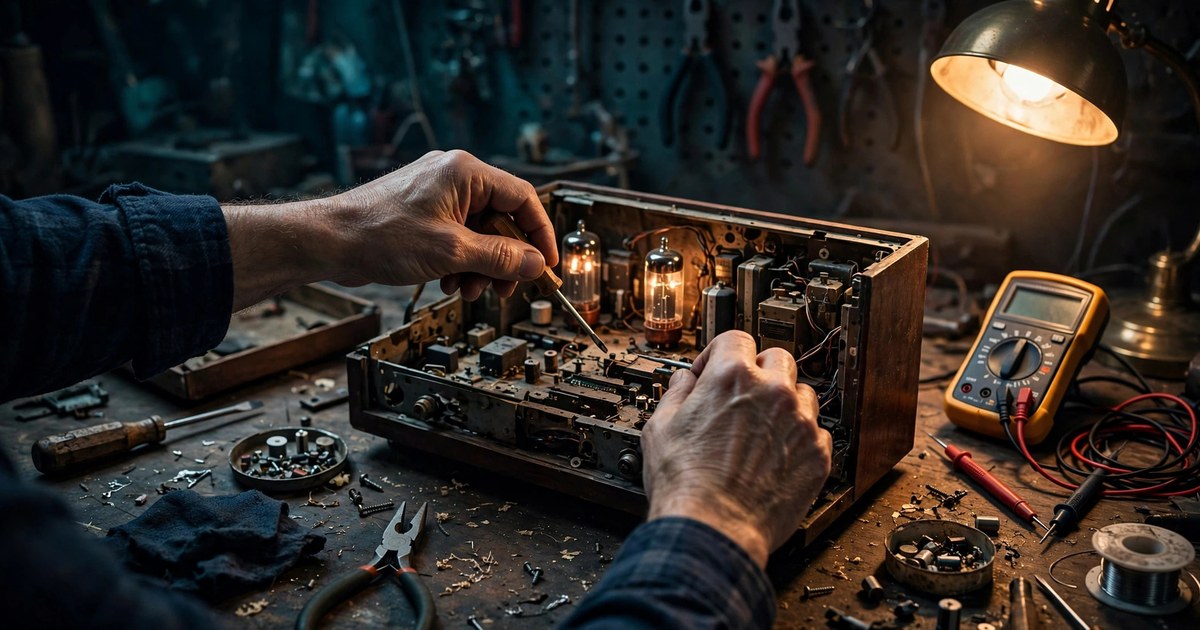
<p>We live in a world that wants you to throw everything away.</p>
<p>Phone slows down? New phone. Toaster acts up? New toaster. Bike needs work? There's a shinier one on sale. The whole economy runs on convincing you that fixing things is for suckers and replacing things is for winners.</p>
<p>I've never bought it. Literally and figuratively. I fix things. Old things, broken things, things other people gave up on. And it's not just habit — it's philosophy. Let me show you what I mean.</p>
<h2>The bike that somebody gave up on</h2>
<p>My 1981 Honda CB650 came to me as a mess. Creative wiring by a previous owner — a car alternator belt-driven off the crank, terminals backwards, a rear harness that looked like it was assembled out of spite. Most people would have looked at it and seen a parts bike.</p>
<p>I saw a motorcycle.</p>
<p>One circuit at a time, I picked through that wiring. Multimeter out, patience on. When the headlight and taillight finally glowed in the dark after weeks of work, it wasn't just a repair. It was a resurrection. That bike runs today because somebody was willing to sit with the mess instead of walking past it.</p>
<p>Here's what fixing it taught me that buying a new bike never could: <strong>you don't really own something until you understand it.</strong> Every wire I traced, every connector I cleaned — that bike and I have an understanding now. A new bike off the showroom floor is a stranger. This one and I are old friends.</p>
<h2>The scooter that became something else</h2>
<p>Then there's the e-scooter teardown — the one I stripped down to build a little single-person buggy on a garden-wagon chassis. Battery, controllers, throttle, motors: all of it survived the teardown and got a second life in a completely different machine.</p>
<p>That's the part people miss about fixing things. It's not always about restoring the original. Sometimes it's about seeing what the parts could become. The scooter was done being a scooter. It wasn't done being useful.</p>
<p>Throwaway culture says an object has one life. Fixers know better. Everything has as many lives as you're creative enough to give it.</p>
<h2>The one I didn't touch</h2>
<p>And here's the twist: sometimes fixing things means knowing when <em>not</em> to.</p>
<p>I had big plans to hot-rod my folding e-bike — dual motors, the works. Then I rode it stock and realized it was already exactly what it needed to be. So I put the wrenches down. The e-bike stayed stock, and the motors went to the buggy where they belonged.</p>
<p>That's part of the philosophy too. Fixing isn't about compulsively modifying everything you own. It's about paying attention — really looking at the thing in front of you and asking what it actually needs. Sometimes the answer is a rebuild. Sometimes the answer is: leave it alone, it was never broken.</p>
<p>Restraint is a repair skill. Knowing the difference between "this needs work" and "I'm just bored" will save you more money and heartache than any tool in the box.</p>
<h2>Fixing is respect</h2>
<p>Here's the core of it, the part I actually believe:</p>
<p>Fixing something is respect. Respect for the thing — somebody designed it, somebody built it, and it deserves better than a landfill because one part wore out. Respect for your money — a repair usually costs a fraction of a replacement, and the difference stays in your pocket. And respect for yourself — because every time you fix something, you prove you can.</p>
<p>There's a confidence that comes from repair work that you can't buy. The first time you bring something dead back to life with your own hands, something shifts. You stop seeing the world as full of mysteries you're locked out of, and start seeing it as full of puzzles you're allowed to solve.</p>
<p>That's not just about bikes and toasters. That's a whole way of moving through life.</p>
<h2>The bottom line</h2>
<p>I'm not saying never buy anything new. I'm saying: before you replace it, ask the question. Can this be fixed? What's actually wrong? Is it the thing that's broken, or is it just my patience?</p>
<p>Half the time, the answer is a twenty-minute fix and a part that costs less than lunch. The other half, you learn something trying. Either way, you come out ahead of the person who just bought a new one and never asked why the old one quit.</p>
<p>Fix the thing. Respect the thing. Respect yourself. That's the whole philosophy — and it's never let me down.</p>
<p><em>Disclosure: This post contains affiliate links. If you buy through them, I may earn a commission at no extra cost to you.</em></p>







Comments (0)
No comments yet — be the first. Comments are moderated, so yours will show up after a quick review.